
Logitech Is Coming for the Big Rooms
For years, Logitech’s collaboration story has been easy to understand. It made meeting-room technology simpler.
That simplicity, combined with aggressive pricing, broad platform support and a huge channel, helped Logitech become particularly successful in huddle spaces and small-to-medium meeting rooms. An IT department could deploy a Rally Bar or similar system without turning every conference room into an AV integration project. For organizations rolling out hundreds or thousands of rooms, that convenience is tremendously valuable.
But after spending a day at Logitech’s headquarters a few weeks ago, it became clear that the company’s vision has become even more ambitious.
Logitech doesn’t just want more meeting rooms. It wants bigger meeting rooms. And in doing so, it is moving directly into territory traditionally owned by the professional AV integration industry.
That may be the most important takeaway from Logitech’s latest product announcements.
Simplify Everything
During Logitech’s Analyst Day in September Henry Levak, the recently appointed General Manager, repeatedly came back to a simple philosophy during the product presentation: simplify everything.
 Henry Levak, General Manager, Team Workspace Solutions, Logitech
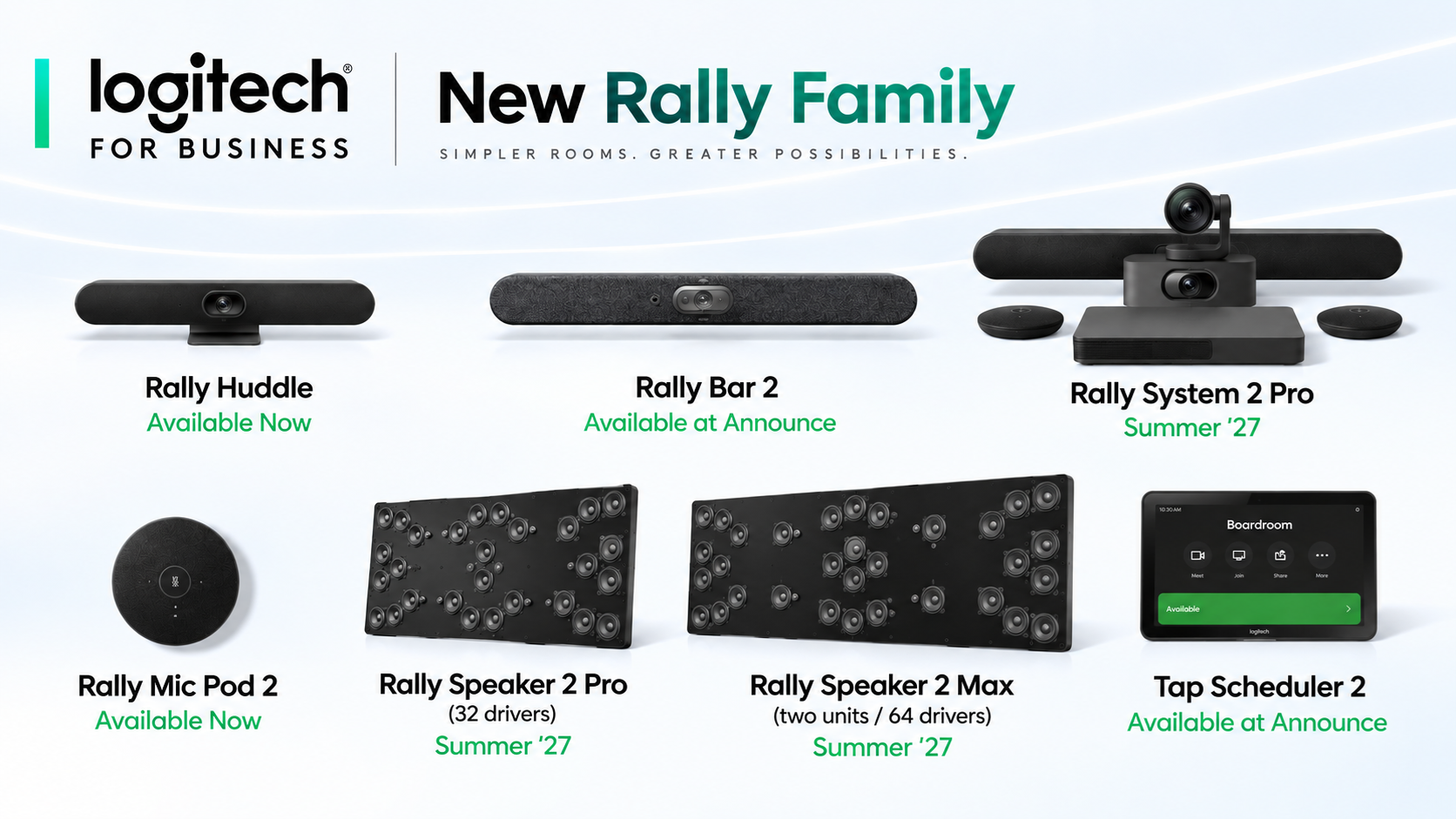
The new Rally Bar 2 extends the company’s familiar appliance approach, but the much more interesting story is what happens as Logitech moves upmarket. Rally System 2 Pro, RoomMate 2 Pro, the new Rally Speaker 2 family and Logitech’s Link architecture are intended to let the company address increasingly large and complicated spaces without adopting the increasingly large and complicated architectures historically used to build them – even for divisible rooms.
Additionally, Logitech is moving all its peripherals onto category-cable connectivity and PoE++, with its homegrown “Link” serving as its AV-over-IP architecture. That puts Logitech in some ways on a path Cisco has already traveled – and it is something AV integrators should examine very closely.
I’ve been cautioning AV integrators for years that their world is changing and that they increasingly need to think and operate more like IT companies than traditional AV companies. They need deeper IT and networking skills and need to adopt more IT practices rather than continuing to rely primarily on traditional AV practices. Logitech’s new architecture is another very visible example of that transition accelerating.
It also potentially threatens an entire ecosystem built around traditional baseband and analog AV wiring. There are integrators that still make significant money pulling, terminating and managing specialized cabling, as well as manufacturers whose businesses depend on the interfaces, adapters, extenders and other components required to make those traditional signal paths work.
As Logitech, Cisco and others move more of the room onto standard network cabling, many of those intermediate pieces simply aren’t necessary anymore. Cameras, microphones, speakers and compute become network-connected endpoints rather than individual components tied together through a maze of specialized AV infrastructure.
That doesn’t eliminate the AV integrator, but it fundamentally changes what customers need the integrator to do – and where the integrator can make money doing it. The more major manufacturers embrace network-based connectivity, the faster this transformation of the AV integration business is going to happen.
I suppose it would have been nice for Logitech and Cisco to get together and have their peripherals connect with the same protocols so they could be interchangeable, but that level of cooperation for the good of the industry is probably going to be more fantasy than reality for a long time.
Have We Been Overcomplicating Audio?
At the same time, Logitech is asking another provocative question: why does a large meeting room still have to be so complicated? It’s a question I’ve been asking for a while, like in this piece about ceiling microphones.
I’ve written many times that microphones and speakers in meeting rooms don’t necessarily need the complicated designs the AV industry has traditionally given them.
Companies such as Shure and Sennheiser have been pushing increasingly sophisticated ceiling microphone and ceiling loudspeaker architectures. Those products can produce excellent results, but they can also turn a meeting room into a substantial AV construction project – requiring general contractors to open ceilings, pull specialized cabling, coordinate multiple trades, and then commission and tune the finished system.
For some rooms, all of that is absolutely justified. But does every medium and large collaboration room really need it? I’ve long argued that it doesn’t.
That’s why what Logitech showed us was so interesting. It wasn’t simply another set of mic pods and speakers. It was an attempt to rethink how the room itself should be designed.
Rethinking the Room Speaker
Traditional large-room audio has frequently meant opening ceilings, pulling cable, dealing with building infrastructure and involving trades well beyond the AV integrator, in part because distributed speakers were needed to achieve consistent coverage without blasting the people in the front just so those in the back could hear.
Logitech’s answer to all that is something it calls Sound Shape.
Instead of relying on conventional distributed room loudspeakers, Logitech has developed multi-driver speaker arrays that use constructive and destructive interference to control where acoustic energy goes. By manipulating the phase and amplitude of multiple drivers, the system can effectively shape the sound field, directing energy toward the people who need to hear it while reducing energy sent toward walls, ceilings and other places where it isn’t useful. This was demonstrated for the analysts by showing the evenness of sound distribution across a large room from a single source, and by propagating different language audio to different parts of the room.
The Rally Speaker 2 family scales that concept for different room sizes. The standard Rally Speaker 2 is designed to support rooms with the furthest participants seated up to 8 meters away.
Rally Speaker 2 Pro extends that to approximately 14 meters, while the largest configuration is intended to reach participants up to roughly 20 meters.
If Logitech can deliver that consistently without putting speakers throughout the ceiling, that’s a big deal. Instead of an integrator painstakingly designing, installing and tuning a traditional distributed loudspeaker system, Logitech’s vision is that the installer can describe the room dimensions and speaker placement and let the technology create the appropriate coverage.
There are still questions here. Acoustics has an annoying habit of reminding people that physics ultimately gets the last vote. Different rooms, surfaces, furniture, reverberation and seating arrangements will challenge any automated system. I want to hear Sound Shape in significantly more environments before drawing conclusions about how far it can replace traditional large-room audio engineering.
But the direction makes a tremendous amount of sense.
Logitech Grows Up – Literally
There are other signs that Logitech understands it is entering a different class of room.
The new equipment we saw makes substantially greater use of die-cast aluminum rather than plastic. That provides better thermal management while also potentially improving both durability and sustainability. It feels like equipment intended to live permanently in professionally deployed rooms rather than peripherals that happen to have migrated from the desktop into a conference room.
The broader architecture reflects the same thinking. Logitech is not trying to win larger rooms by simply making a bigger video bar. It is separating compute, cameras, microphones and loudspeakers while attempting to retain the simplicity that made its integrated products successful.
The professional AV industry has sometimes treated complexity as evidence of capability. Logitech is betting that enterprises increasingly want the capability without the complexity.
And Logitech certainly has the scale to test that theory. The company made clear that it expects Logitech for Business to grow substantially over the coming years, with ambitions to nearly double the business over roughly the next six years. Its opportunity is also expanding beyond traditional enterprise IT into areas such as education, healthcare and the public sector. Moving upstream into larger collaboration spaces gives it another substantial growth opportunity.
Premium Instead of Cheap
There was another interesting lesson in Logitech’s strategy discussion.
For years, it would have been easy to assume Logitech’s natural advantage was simply being cheaper. But that’s not the direction the company described.
In fact, Logitech discussed an experiment with lower-cost meeting-room hardware that essentially failed. Customers weren’t particularly interested in saving a relatively small amount of money if doing so meant getting less capable processors and less headroom for future functionality, particularly AI. The cheaper configuration sold only a few hundred units and is heading to end of sale.
That’s fascinating. Enterprise customers apparently aren’t asking Logitech to race to the bottom. They’re asking for simpler systems, but they still want premium experiences and enough horsepower to support whatever comes next.
There’s a significant difference between simple and cheap. Logitech seems to have figured that out.
And Then There’s MDEP
Logitech also used the meeting to address the elephant that has been sitting in its Android room for quite some time: Microsoft Device Ecosystem Platform, or MDEP.
Logitech had been the conspicuous major holdout. Part of the problem was practical. Its existing installed base and hardware architecture predated Microsoft’s MDEP direction, and simply replacing everything wasn’t particularly attractive for Logitech or its customers.
The company says it has resolved this challenge by co-engineering a solution with the Microsoft MDEP team that integrates the required MDEP components where needed, without requiring the entire Logitech environment to run natively on MDEP. Think of it as being able to turn the necessary MDEP components on when they’re needed for Microsoft Teams while retaining Logitech’s own underlying environment where they aren’t.
Logitech described this as a fully Microsoft-certified approach, and then went even further, suggesting that other manufacturers will ultimately adopt essentially the same architectural model they’ve created.
That’s a bold claim. It’s also one I’ll be watching carefully because I’ve heard some interestingly similar assertions from other manufacturers.
Regardless of who ultimately gets credit for the architecture, resolving the MDEP question removes one of the more significant clouds that had been hanging over Logitech’s Microsoft Teams Rooms strategy.
The Channel Has to Change Too
There’s another implication to all of this. If Logitech succeeds in simplifying large rooms, the role of the AV integrator changes.
That doesn’t mean the integrator disappears. Quite the opposite. Large enterprises still need people who understand room design, deployment, networking, acoustics, management, support and increasingly how collaboration technology fits into the broader workplace.
But value moves away from how many boxes an integrator can install and how complicated a system it can engineer. Logitech talked about the evolving role of the channel, and that’s exactly the conversation the industry should be having.
As microphones become easier to deploy, speakers become more automated, devices run over standard category cable and cloud management handles more of the ongoing support, integrators need to create value elsewhere – in design, deployment, adoption, workplace strategy, AI, analytics and support.
That’s not the death of integration. It’s the long-needed evolution of the integration business that I’ve been predicting for decades.
One Other Thing Changed
There was another part of the September analyst day visit that shouldn’t be overlooked because it wasn’t a product.
Logitech opened the doors.
The company invited analysts into its headquarters, showed us products well before release, explained what its engineers were trying to accomplish and then let us ask questions – including uncomfortable ones.
That’s how analyst relations is supposed to work.
Analysts aren’t there merely to repeat press releases. Give us access early enough and we can point out issues, question assumptions, identify opportunities and provide constructive criticism while there is still time for that feedback to accomplish something.
That is especially valuable when a company is entering unfamiliar territory.
Contrast that with Shure’s recent launch of its video bar. Shure entered that market without giving independent analysts meaningful advance access to look under the covers and understand what it had built. That’s certainly a company’s prerogative, but it eliminates an opportunity to get knowledgeable outside perspectives before the market gets the finished product, and raises enormous red flags about what they may have been hiding.
Logitech appears to be moving in the opposite direction, and I hope it continues. It’s refreshing to see a company of Logitech’s size recognize that analyst engagement isn’t just about briefing us on finished products and hoping we say nice things. Sometimes the most useful thing we can tell a manufacturer is what we don’t like about something before it ships.
That’s how products get better.
Now Let’s See If It Works
I came away from the visit intrigued.
Logitech still has plenty to prove. A company that has been tremendously successful simplifying smaller meeting rooms doesn’t automatically become a large-room AV engineering company because it connects products with Cat6 cable. Sound Shape needs to demonstrate that it can deliver consistent coverage across the ugly variety of real-world rooms. The new modular architecture has to prove that simplicity doesn’t come at the expense of flexibility.
But I like the direction.
Large meeting rooms have been too complicated for too long, and some of that complexity exists because the industry has continued doing things the way it learned to do them decades ago. Logitech isn’t saying large rooms don’t require engineering. It’s asking whether we can put more of that engineering inside the products instead of requiring every room to be individually engineered and tuned from the ground up.
That’s a distinction worth paying attention to.
If Logitech can take what it learned democratizing the smaller meeting room and apply that same philosophy to larger spaces, it could force some very healthy conversations throughout the AV industry.
Of course, the proof comes out in the actual testing, which is something I intend to do once the new gear is available.
When it arrives, I’ll put it on my test bench, get it into real rooms and find out whether simplifying everything actually works.
Because that is when this story gets really interesting.