
Cisco Completes Its Collaboration Room Vision – By Making It Part of the Digital Workplace
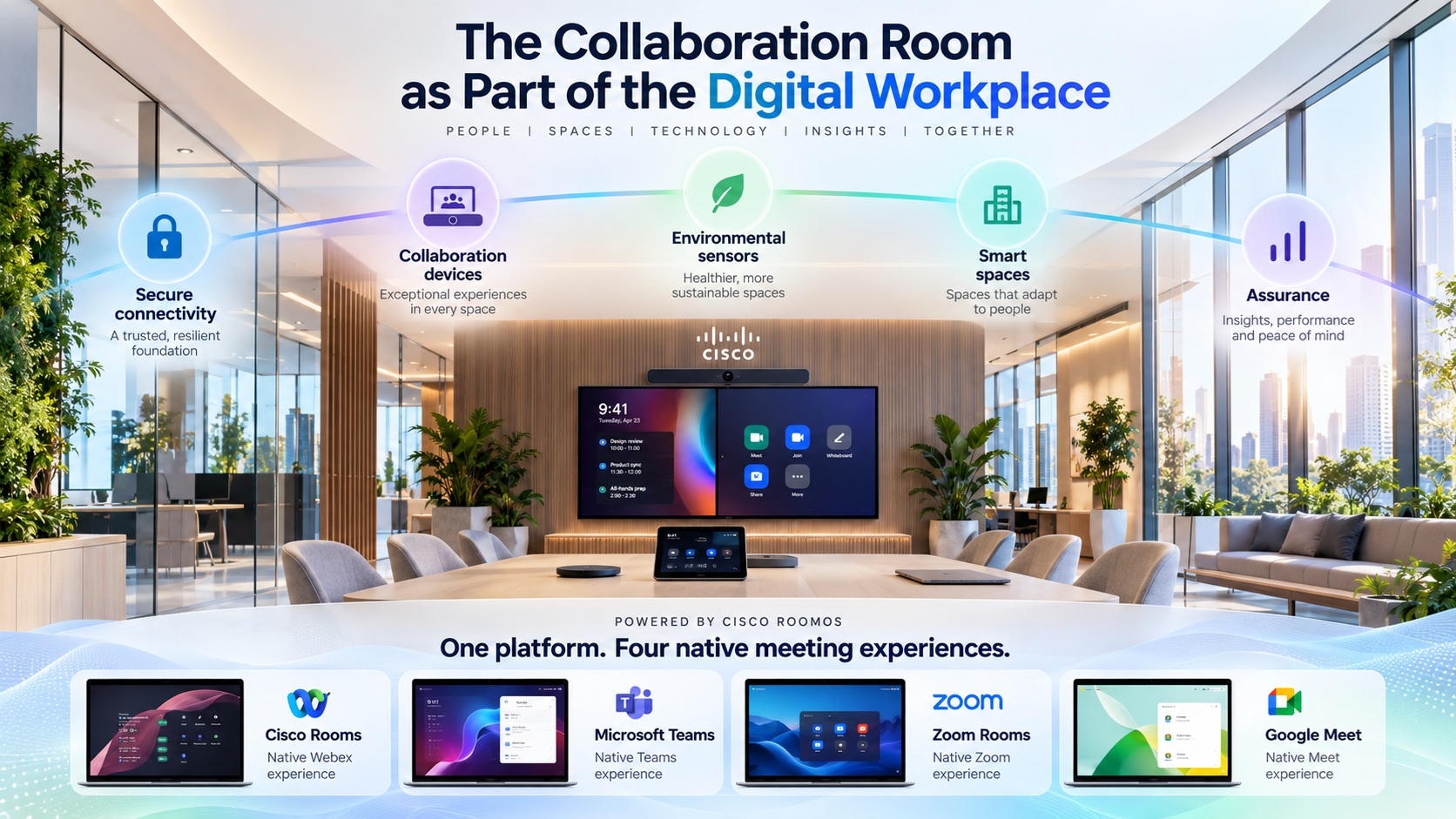 Cisco made a lot of announcements at WebexOne this morning, and many of them extend well beyond what most of us would traditionally call collaboration. That is exactly why I think the collaboration story is more interesting this year.
The important announcements are not simply a new ceiling speaker, a new operating system, another design tool and another management dashboard. Cisco is filling in the pieces of a much larger architecture in which the meeting room becomes one intelligent part of the overall digital workplace – tied into networking, environmental awareness, facilities, device management and the communications platforms people actually use.
From a collaboration perspective, that is the story I would pay attention to. Cisco is not merely releasing a new product for rooms. Rather, it is completing its vision of the collaboration room, then connecting it to everything around it.
The Room Gets Its Missing Voice
The most tangible new product is Ceiling Speaker Pro. On the surface, Cisco has introduced its own networked ceiling loudspeaker. In the context of everything else it has been building, though, the announcement means much more than that.
Cisco has spent years giving the room increasingly sophisticated eyes and ears. Its cameras can identify and frame participants. Its microphones can locate voices. Sensors and telemetry can tell the system what is happening in the space and how the room is behaving. Ceiling Speaker Pro adds the other half of that conversation – the room now has an intelligent way to put sound back into the physical space.
Cisco describes the new speaker as an IP peripheral with power, audio and control on a single Ethernet connection, embedded DSP, automatic configuration and centralized management. More importantly, Cisco is not treating it as a standalone loudspeaker. Cameras, microphones, speakers and room devices are intended to operate as one coordinated system.

That is what enables the three forms of voice lift Cisco demonstrated: local voice lift for people speaking across longer tables, presenter voice lift for larger spaces, and remote voice lift that can spatially distribute far-end participants through the room. The objective is not simply to make people louder. It is to understand who is speaking, where people are located and where sound should be delivered.
That fills an important hole in Cisco’s collaboration architecture. The room can see, hear, sense its own condition and increasingly speak back intelligently. The individual devices matter, but the much bigger story is the system they create together.
RoomOS Becomes the Intelligence Layer
RoomOS 27 is the new software piece that ties much of this together. Cisco is describing it as the secure operating system for intelligent workplace experiences, which is a much broader definition than simply the operating system inside a videoconferencing endpoint.
That shift is significant. RoomOS is increasingly becoming the intelligence and orchestration layer across cameras, microphones, speakers, room devices, AI functions, management and meeting-platform interoperability. Cisco says RoomOS 27 is focused on AI at the edge, workplace management and comprehensive interoperability.
That also changes the way we should think about room commissioning and support. Cisco’s Smart Room Assurance direction is about using software, telemetry and the same underlying platform to help design, calibrate, monitor and troubleshoot the space. Instead of treating installation as one activity and ongoing operations as another, Cisco is trying to make the room continuously understandable to the platform that manages it.
And the Platform No Longer Stops at the Door
This is where its new Workplace Designer and management capabilities become much more important than their names might suggest.
Cisco’s Room Designer was useful because it helped people model and plan collaboration spaces. Cisco is now expanding that concept into Workplace Designer. The unit of design is no longer just the conference room. It is the workplace around it – the rooms, devices, people, network and environmental conditions that collectively determine whether the workplace actually functions.
The same expansion is happening on the operational side. Cisco’s workplace management environment is increasingly able to correlate collaboration-device information with broader experience data. The administrator is no longer limited to asking whether a codec is online or whether a microphone is healthy. The console can help expose where Wi-Fi experience is deteriorating, where temperature or environmental conditions are becoming a problem, where occupancy and congestion are developing, and where an AV device or collaboration system is producing trouble.
That matters because users never experience those things as separate technology domains. Nobody walks into a meeting room and says the videoconferencing system is healthy but the wireless network is failing, the room is too hot and there are twice as many people in the space as it was designed to support, so therefore the collaboration experience is technically fine. To the user, the room either works or it doesn’t.
Cisco is increasingly managing toward that reality. Its collaboration products are becoming part of a broader integrated communications and digital-workplace platform rather than an isolated UC application stack. Networking, room systems, sensors, environmental data, workplace analytics and management begin to converge into one operational picture.
Interoperability Finally Matches the Enterprise Story
That broader platform story would be much less compelling if Cisco still required customers to make Webex the center of every room. Cisco has steadily been building toward native platform interoperability, and this morning it filled in the last major piece by adding Google Meet.
Cisco room systems now have native experiences across the four major meeting platforms: Webex, Microsoft Teams, Zoom Rooms and Google Meet. Zoom Rooms support is going GA in October, while Google Meet is targeted for Q4 2026. With Google Meet added, Cisco has completed the native-platform story it has been building for several years.
For a large enterprise, that is a very big deal. Meeting rooms live far longer than meeting-platform strategies. Companies acquire other companies. Business units standardize on different services. Contracts change. Customers and partners send invitations from different ecosystems. Executives do not care which logo is on the invitation – they want the room to work.
Cisco can now make a much cleaner enterprise argument: choose the room infrastructure because of the hardware, manageability, security, lifecycle and integration with the rest of the Cisco environment, then let the meeting experience be Webex, Teams, Zoom or Google Meet as the business requires.
Cisco devices will naturally remain most deeply integrated with Webex, but native support across all four major platforms changes the buying equation. Interoperability stops being a workaround and becomes part of the architecture. For enterprise-grade room systems, that is exactly where it belongs.
This Is the Bigger Cisco Story
It would be easy to write about Ceiling Speaker Pro, RoomOS 27, Workplace Designer, Workplace Insights, Experience Metrics and Google Meet support as a collection of unrelated WebexOne announcements. I think that misses what Cisco is actually doing.
Cisco is completing its vision of the collaboration room by making the room one managed, intelligent component of a much larger digital workplace. The cameras, microphones and speakers understand the physical space. RoomOS coordinates them. The management platform watches the health and experience of the room. Workplace Designer extends planning beyond the four walls. Networking and environmental telemetry explain problems that would otherwise look like mysterious collaboration failures. And native support for Webex, Teams, Zoom and Google Meet means the room is not trapped inside one meeting ecosystem.
That is a far more interesting proposition than simply building a better video endpoint.
It also plays directly to Cisco’s historic strength. Cisco has always been at its best when it can connect infrastructure layers that other companies sell as separate islands. Collaboration, networking, management, security and workplace intelligence are increasingly being presented as parts of one integrated environment rather than separate product families.
There are still plenty of things I want to see work outside a briefing. I want to hear the new voice-lift system in difficult real rooms. I want to see how much configuration and calibration the new audio architecture truly removes. It still requires distributed speakers around the room, just as some competitors are beginning to argue that large-room audio can be accomplished with substantially less installation complexity. I want to see whether Workplace Designer becomes a tool people actually use rather than an attractive planning demo. And I want to see how cleanly enterprises can move among the four native meeting experiences in day-to-day operation.
But the direction is much clearer now.
Cisco has spent years making its collaboration rooms smarter. With these announcements, it is connecting those rooms to the rest of the digital workplace – and making the collaboration system part of a much larger operational picture.
That, more than any one product announced this morning, is the WebexOne collaboration story.