
Microsoft Ignite 2026: Lots of Agents, Not Much Teams, and a Little Too Much Water
Microsoft’s vision for the future of work is becoming clearer. So are some of the questions about who will control that future.
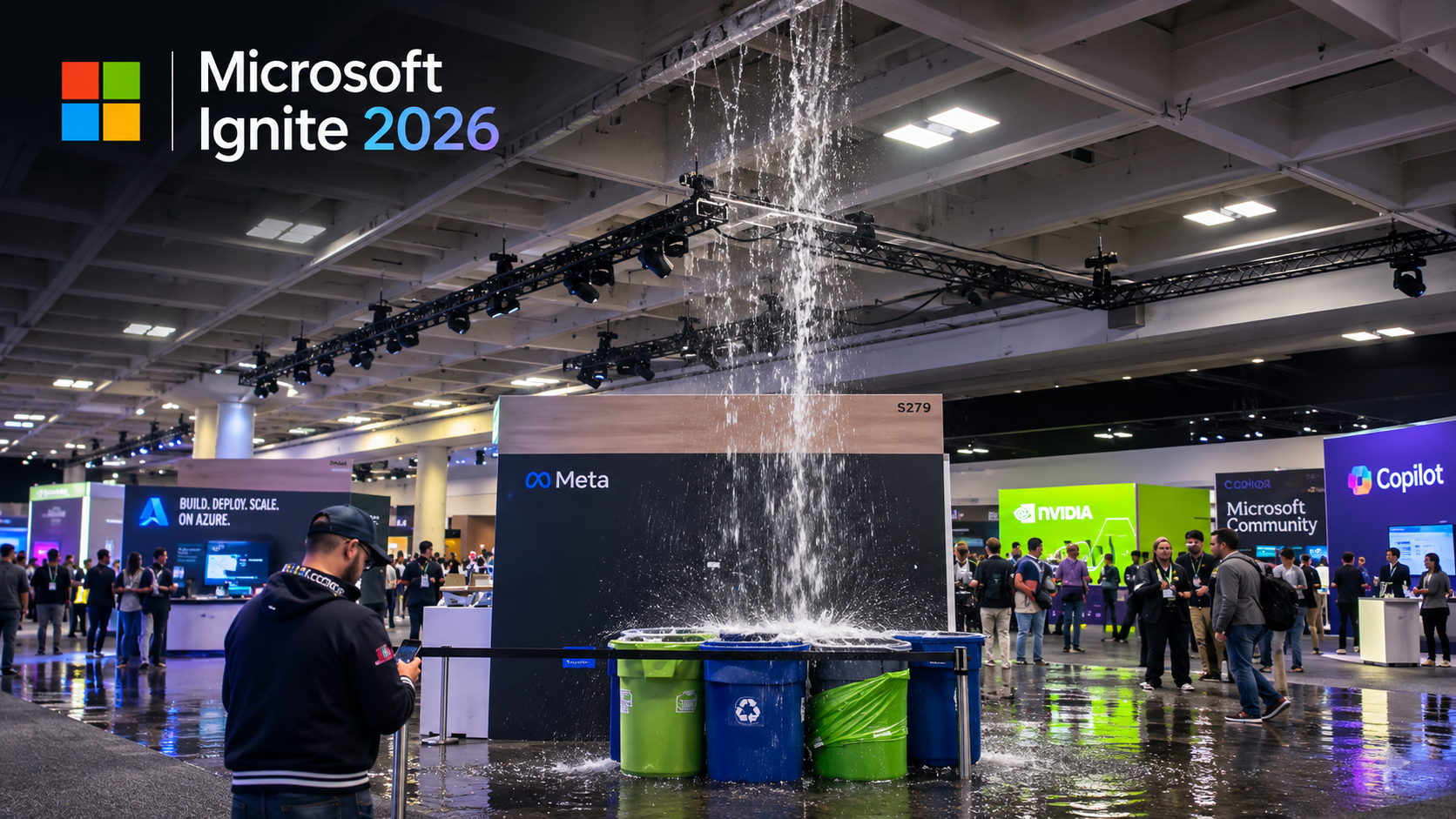
Microsoft Ignite 2026 was an event I followed closely, but thankfully not in person. While some of my industry colleagues were attending presentations and exploring the exhibit floor in San Francisco, I was reviewing announcements and following developments from a considerably drier location. As it turned out, that was a good decision. My sneakers didn’t need several days to dry out.
San Francisco experienced a significant storm during Ignite, with water pouring through the ceiling of the Moscone Center and onto portions of the Microsoft Ignite Hub exhibition floor. Videos circulated showing water cascading near exhibitor displays, and Microsoft temporarily closed the Hub. The rain was so severe that Waymo suspended its autonomous taxi service in the Bay Area. It was an unfortunate situation for everyone involved, and hardly a ringing endorsement of San Francisco’s suitability for such a major event.
The weather was outside Microsoft’s control, of course. But the irony was difficult to ignore. A conference dedicated to autonomous technology was disrupted by something as ordinary as rain, and even the autonomous cars decided to stay home. Just days earlier, Microsoft had experienced a significant Microsoft 365 service disruption, which CEO Satya Nadella acknowledged during his keynote. The contrast between Microsoft’s ambitious vision and the vulnerabilities of the infrastructure upon which we increasingly depend was striking.
After reviewing the major announcements and presentations, I came away with three observations. First, Microsoft’s seemingly endless changes in AI strategy, terminology, and positioning risk undermining its credibility. Second, Teams has clearly lost its position at the center of Microsoft’s strategic messaging. And third, potentially most consequential, Microsoft is increasingly willing to integrate its technologies with competing platforms, creating opportunities for cooperation today that could become competitive threats tomorrow.
Whatever Happened to Teams?
For those of us who have spent years following Microsoft’s evolution in unified communications and collaboration, Teams has been one of the company’s most important success stories. It has become a central environment for enterprise meetings, messaging, telephony, and meeting room experiences.
Yet Teams was hardly the centerpiece of Ignite 2026.
There were Teams-related announcements and presentations, but exhibiting sponsors and partners seemed considerably more enthusiastic about promoting Teams solutions than Microsoft itself. One exhibitor privately described its participation to me as paying “tribute” to Microsoft and indicated this would be its last Ignite as a sponsor. That’s only one company’s perspective, but it illustrates the disconnect between what some partners came to promote and what Microsoft chose to emphasize.
The new stars were Copilot, Work IQ, Microsoft IQ, Autopilot, Workspaces, and Agent 365. Teams appeared within some announcements, but was not a central theme of Nadella’s keynote. If you were looking for a major Teams Rooms announcement, an exciting conferencing development, or a breakthrough in meeting interoperability, Ignite offered relatively little.
That doesn’t mean Teams is going away. It remains enormously valuable to Microsoft, commercially and as a source of enterprise context. But in Microsoft’s emerging vision, collaboration is less about bringing people together through communications tools and more about accomplishing work through an ecosystem of people, applications, information, and autonomous agents. Teams is still part of that ecosystem. It simply isn’t necessarily the center anymore.
Another Day, Another Microsoft AI Strategy
Ignite reinforced the industry’s rapid transition from AI assistants that respond to requests toward agents that undertake activities independently. Microsoft is taking that transition very seriously, perhaps more seriously than some customers are prepared for.
Copilot is being repositioned as a primary environment in which work is initiated, managed, and completed. Work IQ provides organizational context from messages, meetings, documents, and activities, while Microsoft IQ extends intelligence across broader enterprise data. Autopilot introduces persistent agents capable of continuing work without new prompts, and Copilot Workspaces provides shared environments for humans and agents. Agent 365 adds the centralized management, identity, security, and cost controls necessary to govern them.
Collectively, these announcements suggest a profound shift in how Microsoft expects enterprises to operate. But they also highlight something Microsoft seems reluctant to acknowledge: its constant reinvention of AI products, architectures, and terminology is becoming exhausting.
Just as customers begin to understand one generation of offerings, another collection of names and capabilities arrives. Microsoft undoubtedly sees this as rapid innovation, but customers trying to establish sustainable technology strategies may see something different. It’s difficult enough to evaluate AI, implement governance, train employees, and demonstrate a return on investment without the supplier continually changing the terminology and architecture.
There’s also enormous FOMO driving AI investments. Suppliers race to introduce agents because they fear competitors getting ahead, while customers race to deploy them because they fear falling behind. The result is that capabilities frequently arrive faster than organizations can establish their usefulness, understand their costs, or implement appropriate controls.
Microsoft may be right about the ultimate direction of enterprise AI. That doesn’t mean customers appreciate being dragged through every intermediate stage of the journey.
The Trojan Horse Strategy
One of Ignite’s most consequential announcements received considerably less attention than the Copilot headlines. Microsoft announced the general availability of Microsoft Contact Center Intelligence (CCI), along with partnerships involving Cisco, Avaya, and Five9.
On the surface, this is customer-friendly. Rather than forcing enterprises to abandon their existing contact centers, Microsoft is offering conversational AI and automation capabilities that integrate with the platforms they already use. Given the expense and disruption associated with contact center migrations, the appeal is obvious.
But there’s another way to interpret this strategy. Microsoft gains access to competitors’ customer environments by offering capabilities those customers want. Once deployed, its technology becomes part of daily operations, with Microsoft’s agents handling interactions, accessing enterprise information, and participating in workflows. Its management systems establish policies, identities, and controls.
Over time, could the intelligence operating above the contact center become more valuable than the underlying contact center platform?
Microsoft’s own announcement provides a revealing clue. After describing how CCI works with existing contact centers, Microsoft characterizes a future move to Dynamics 365 Contact Center as a “seamless upgrade.”
Microsoft is effectively telling customers they don’t need to replace their contact centers today. They can begin with Microsoft AI services and potentially migrate to Microsoft’s complete platform later. It’s a smart strategy, but one with obvious competitive implications.
This isn’t evidence of a secret plan to undermine partners. Microsoft is fairly open about the migration opportunity, and Cisco, Avaya, and Five9 certainly understand the competitive landscape. But partnerships between competitors carry risks, particularly when one partner provides technology that could eventually diminish the importance of the other’s core offering.
The Trojan horse comparison seems appropriate, provided we remember that the gates are being opened voluntarily.
NICE and Salesforce: Different Partnerships, Similar Questions
Other Ignite announcements reinforced this evolving strategy, although the relationships aren’t identical.
NICE announced expanded integrations between NICE Cognigy and Microsoft, including certification for the Teams Unify integration model for voice agents. Another integration connects Cognigy with Azure, Teams, and Dynamics 365 Customer Service. One particularly interesting scenario allows an AI agent to consult a human expert through Teams while continuing its customer conversation, potentially resolving an issue without transferring the interaction.
This is precisely the kind of practical human-agent collaboration Microsoft’s broader announcements envision. NICE is also bringing its own AI capabilities into Microsoft’s environment, making this different from the CCI partnerships. Nevertheless, it illustrates how the boundaries between collaboration, customer experience, and enterprise workflows are disappearing.
Microsoft also announced Copilotforce, expanding its Salesforce partnership to bring Salesforce information and functionality into Copilot, Teams, and Microsoft Fabric. The customer benefit is straightforward: employees can access business information and initiate activities without constantly switching applications.
But consider what happens when users spend less time interacting directly with their business applications and more time interacting with a Microsoft AI environment that accesses those applications for them. Who owns the relationship with the user? Who controls the daily working experience? Which company becomes indispensable?
These questions extend well beyond Salesforce and contact centers. Microsoft appears to be creating an environment in which partners continue supplying specialized applications while its own AI platform increasingly controls how users interact with them. That’s convenient for customers, but the longer-term implications for Microsoft’s partners deserve attention.
The Collaboration Industry Needs to Pay Attention
Much of the collaboration industry continues to compete on familiar terms: camera quality, audio performance, meeting interoperability, room intelligence, management, and user experience. These remain essential capabilities, but Ignite suggests Microsoft is preparing for a future in which they are increasingly infrastructure rather than primary sources of strategic value.
If an AI agent schedules a meeting, gathers information, participates in the discussion, identifies decisions, and manages follow-up, the meeting application becomes just one component of a larger process. Similarly, if AI manages customer interactions, accesses enterprise knowledge, executes transactions, and coordinates human participation, the underlying contact center infrastructure may become increasingly commoditized.
That doesn’t mean established collaboration and CX vendors are doomed. Many have sophisticated AI strategies, valuable customer relationships, and specialized expertise. But the basis of competition is changing. Vendors must increasingly consider whether they control a meaningful portion of the intelligence and workflow environment or merely provide components consumed by someone else’s platform.
For enterprise buyers, the question is equally important: how much control are they willing to surrender to a single technology supplier?
Ambition Versus Execution
Microsoft used Ignite to describe an enterprise future dependent upon persistent agents, interconnected systems, and centralized AI intelligence. Yet the conference began with Nadella acknowledging a major service disruption, followed by flooding that temporarily closed portions of the physical event.
The flooding wasn’t Microsoft’s fault, and a leaking convention center roof doesn’t invalidate its AI strategy. But both incidents remind us that technical ambition and operational reliability are different things. If autonomous systems are going to participate in increasingly consequential business activities, the infrastructure supporting them must be extraordinarily dependable. Enterprises also need to understand what happens when systems fail, agents make mistakes, or dependencies on one supplier become difficult to unwind.
My biggest takeaway from Ignite 2026 isn’t that Microsoft announced more AI features. We expected that. It’s that Microsoft appears to be changing where it intends to sit in the enterprise technology stack.
Teams, Dynamics, Office, and Microsoft’s cloud services remain important. But Microsoft increasingly wants to own the intelligence, orchestration, and working environment that connects them, including products supplied by competitors. That is much more consequential than introducing another collaboration application.
The question for the rest of the industry is whether Microsoft’s expanding role creates opportunities for partnership or gradually reduces its partners to interchangeable components. We won’t know the answer for some time, but Ignite provided plenty of reasons to start asking.
And for those of us watching from home, it provided one more benefit: dry sneakers.